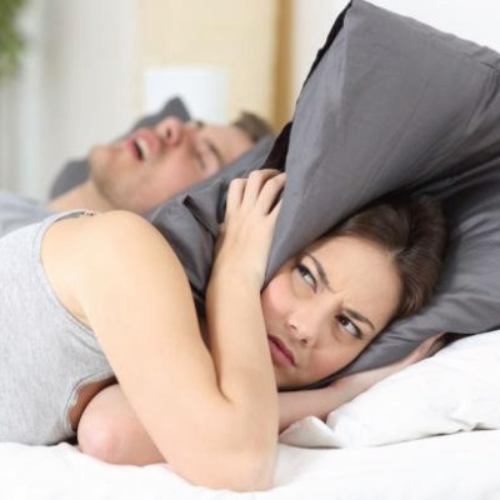
Do you snore at night and feel unrested in the morning? Or do loud snoring noises keep you from sleeping? Even though snoring is usually harmless, it can have unpleasant side effects in certain cases.
What are the causes?
About 30 percent of adults snore. During sleep, the muscles of the upper airways relax. The soft palate, uvula, and tongue slacken, and the airways narrow. As air flows through this narrow passage, the typical snoring sounds are produced.
Snoring can have a wide variety of causes. Most can be prevented by leading a healthy lifestyle. Common reasons include:
- Breathing through the open mouth instead of the nose
- Nasal polyps or congenital narrowing of the nasal passages
- Allergies
- Anatomical causes, e.g., enlarged tonsils, large uvula, etc.
- Being overweight
- Sleeping on your back
- Medications, nicotine, and alcohol
When is snoring no longer harmless?
In most cases, snoring is generally harmless to the person affected, but it is often very disruptive to those around them. Further evaluation is necessary as soon as the person affected…
- no longer wakes up feeling rested in the morning.
- no longer feels fit and productive.
- feels sleepy during the day
- regularly experiences pauses in breathing.
In children, snoring should always be investigated.
Simple tips to reduce snoring:
- Avoid alcohol and sleep aids, as these can cause the soft palate to relax further
- Choose a mattress that allows for a relaxed and comfortable side-sleeping position.
- Avoid sleeping on your back.
- Use a suitable neck support pillow when sleeping on your side.
- Raise your upper body by about 5–6 cm. It is extremely important to raise not just the head of the bed but the entire back, otherwise the spine will become curved.
- If raising the entire upper body is not possible, you can also raise the entire slatted frame from the head end.
- Stuffy nose? For a cold, a nasal rinse with saline solution is recommended.
- Light dinner
- Good indoor climate: Temperature not below 18°C and humidity between 40% and 60%