Focus on Reclining Positions

The right sleeping position is key to a restful night’s sleep and waking up pain-free. Read here about the pros and cons of each sleeping position.
Supine Position
In the supine position, the legs are inevitably stretched out. This causes the trunk flexor muscles to tense and pull the pelvis forward. The spine is pulled upward in the lumbar region. This results in an increased hollow back. People who sit a lot during the day will already show initial shortening in the trunk flexors, which further intensifies this effect. You may feel the need to bend your legs or place a pillow or similar item under your knees.
A slatted bed frame is recommended, one where the knee angle can be adjusted and the long back section can be raised slightly.
Side-lying position
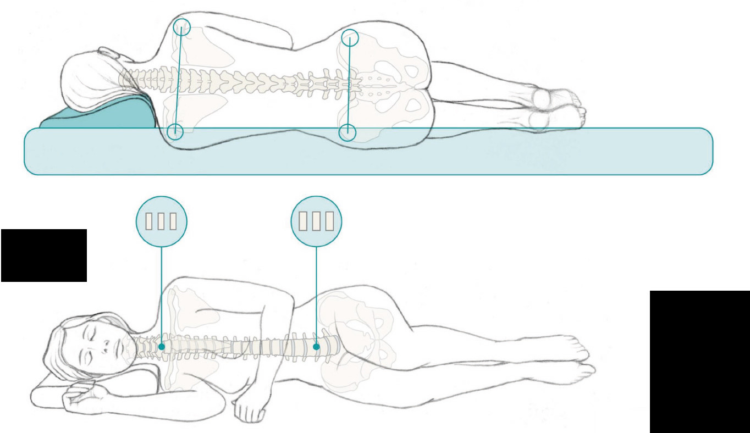
This favorite position for most people allows for maximum relaxation due to the slightly hunched posture (fetal position). However, the differences between head, shoulder, waist, and hip widths that need to be balanced out are greatest here. Many beds lack sufficient elasticity in the shoulder area, and the shoulders do not sink deeply enough into the mattress.
In this case, the body automatically begins to compensate for the bed’s lack of adaptation by adjusting its lying position. For example, the shoulders are pulled slightly forward to reduce pressure. The same often happens with the pelvis when the waist receives insufficient support and sags. This twisting of the upper body and pelvis—often in the opposite direction—creates a compensatory tension that can escalate to the point of causing pain.
Prone Position
The prone position is not a good choice because the lordosis in the lumbar spine is severely arched in this position. In contrast, some sleepers try to reduce the hollow back by placing their hands under their abdomen or bending one leg to the side. This leads to numb hands and additional muscle tension in the lower back, triggered by the tilting of the pelvis. Added to this is a rotation of the cervical spine caused by turning the head to the side, which shortens the neck muscles on one side and overstretches them on the other—making pain inevitable.
The bed should adapt to you, not the other way around, because a properly adjusted mattress allows for a relaxed side and back sleeping position. You are sure to find your own optimal sleeping position at a Kompetenzzentrum Schmerzfrei Schlafen through a detailed lying and sleeping analysis.